
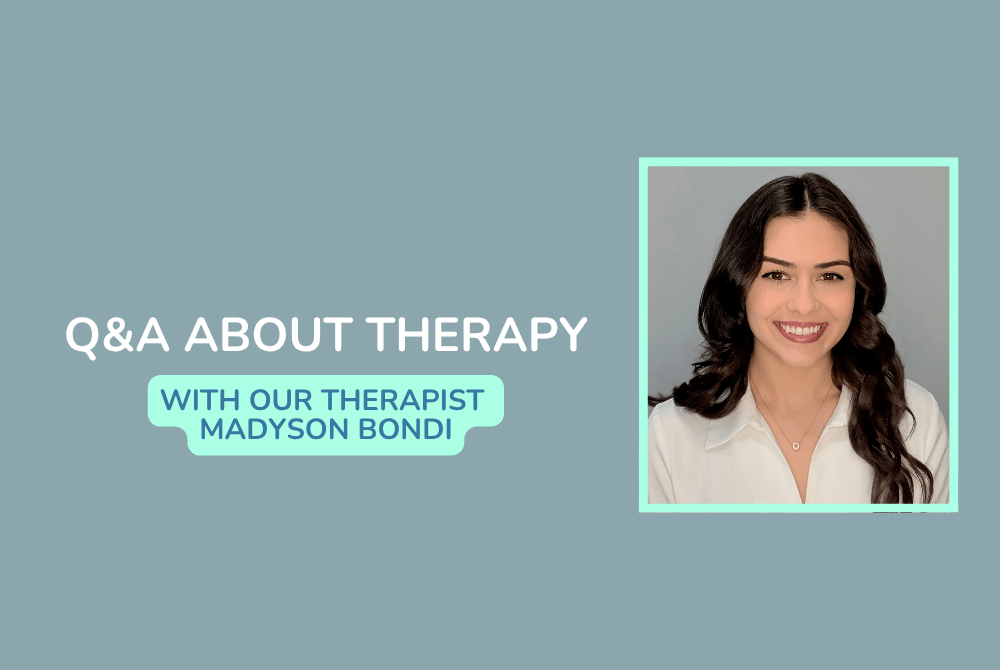
Q&A About Therapy with Madyson Bondi
What does a typical session with you look like, and how do you decide which approaches (CBT, DBT, ACT, IFS, somatic work) to use with each client?
Answer: When I first begin working with a client, I prioritize getting to know them and understanding what brought them into therapy. Together, we talk more about what they’re hoping to gain from our work and identify goals that feel meaningful to them. Those goals often evolve over our work together. I don’t believe there is a one-size-fits-all approach to therapy. As I get to know each person, I’ll pay attention to what resonates with them, such as the language they connect with, the ways they make sense of their experiences, and the tools that feel most helpful. Instead of asking clients to fit into a specific therapeutic model, I will adapt my approach to fit each person.
Most sessions begin with a check-in, so I can understand how my client has been feeling emotionally, mentally, and physically since we last met, and what feels most important to focus on that day. Some days, a client may come in feeling overwhelmed, stuck, or emotionally flooded. In those moments, our work might focus on creating a greater sense of safety and stability. This may look like grounding, coping skills, or reconnecting with the present moment. Other times, when a client feels more supported and grounded, we may explore deeper patterns, emotions, relationships, or past experiences. Meaningful change happens when people feel safe enough to approach the parts of themselves and their stories that need attention.
No matter what we might be working on, my goal is to create a space where clients feel genuinely seen, understood, and accepted. At the same time, I gently encourage them to move toward the life they want to build and the values that matter most to them. Therapy is a collaborative process, and I see my role as walking alongside clients as they learn, heal, and grow.
How do you help clients who feel stuck in chronic stress, overthinking, or racing thoughts actually slow down and feel more in control day to day?
Answer: Slowing down can be difficult, especially for those who have spent years operating in survival mode, managing chronic stress, overthinking, and/or feeling like their mind is constantly racing. Many of the clients I work with are used to “pushing through,” staying busy, or remaining on high alert, often without realizing how exhausting that can be. In our work together, I help clients become more curious about their stress responses and develop a more compassionate relationship with themselves. Rather than judging reactions, we explore them with curiosity and work to better understand what the mind and body may be trying to communicate.
Part of that process involves gradually expanding the range in which we can navigate life’s challenges while still feeling present, grounded, and connected to ourselves. As that capacity grows, many people find that everyday stressors feel more manageable and less overwhelming. For some clients, slowing down might look like mindfulness practices, intention-setting, or gratitude. For others, it may look like learning to pause before reacting, listening more closely to their body’s signals, or creating moments of rest and reflection throughout the day. There is no single right way to do it.
Over time and with consistency, clients often find they feel more grounded, more connected to what matters most to them, and better able to respond to challenges with intention rather than react automatically. My hope is that therapy helps people build a greater sense of balance, confidence, and trust in themselves as they move through daily life.
What does trauma-informed therapy look like in your work, especially for clients with complex trauma or attachment wounds?
Answer: For me, trauma-informed therapy begins with creating a relationship where clients feel safe, supported, and genuinely understood. Before any deeper work can happen, it’s important that people feel they can show up as they are and trust that they will be met with compassion rather than judgment. I believe that healing often happens within relationships, which is why the therapeutic relationship itself is such an important part of the process. As trust develops, clients are often able to be more open, honest, and vulnerable. Sometimes, simply having a different relational experience, one where they feel seen, heard, and accepted, can be deeply healing on its own.
Throughout our work together, I incorporate education about trauma, the nervous system, and attachment in ways that help clients better understand themselves and make sense of their experiences. Rather than clients asking, “What’s wrong with me?” many begin to shift towards asking, “What happened to me?” and “How did these responses help me survive?” That shift can be incredibly powerful.
Together, we explore the beliefs, patterns, and protective strategies that developed throughout a client’s life, viewing these responses with curiosity and respect, recognizing that they often served an important purpose at one point. As safety and self-understanding grow, clients may feel more able to gently explore difficult emotions, revisit experiences that have shaped them, and challenge beliefs that no longer reflect who they are today. My role is to support that process at a pace that feels manageable, empowering, and aligned with each client’s unique needs, strengths, and goals.
How do you support clients navigating ADHD or executive dysfunction without turning therapy into just “productivity coaching”?
Answer: When working with clients navigating ADHD or executive functioning challenges, I like to balance practical skill-building with deeper exploration and self-understanding. Together, clients and I identify strategies that support organization, time management, task initiation, emotional regulation, and follow-through in ways that feel realistic and sustainable.
I also believe it is important to look beyond symptoms and explore the larger context in which these challenges occur. Executive functioning difficulties can often be shaped by factors such as stress, burnout, nervous system dysregulation, trauma, environmental demands and other past experiences.
Part of my work with clients involves helping them better understand how their brains function, recognize their strengths, and develop systems that work with them rather than against them. I also support clients in challenging shame-based beliefs and cultivating greater self-compassion. My goal is not simply to improve productivity, but to help clients create lives that feel more manageable, meaningful, and aligned with their values.
What is your approach to helping clients work through emotional dysregulation, anger, or relationship conflict in real time?
Answer: I believe that relationships offer valuable opportunities to learn more about ourselves and strengthen skills such as emotional regulation, communication, conflict resolution, and anger management.
My approach often begins with helping clients build mindfulness and present-moment awareness. Developing the ability to “slow down” and notice thoughts, emotions, and reactions creates a foundation for lasting change. At the same time, I encourage clients to become more reflective of their relational patterns, triggers, and responses so we can better understand what may be contributing to recurring challenges.
Over time, the goal is to help the client strengthen their ability to recognize these patterns in the moment and respond with greater intention rather than react automatically. As insight and awareness grow, clients can begin applying coping skills and new perspectives to support healthier communication, emotional regulation, and more fulfilling relationships.
Meaningful change takes time. I try to remind folks that while new skills may not feel natural or effective right away, growth is often a gradual process. I strive to bring patience, curiosity, and compassion to that process, supporting clients as they build confidence and create lasting change one step at a time.
How do you incorporate mindfulness or somatic work for clients who feel disconnected from their body or overwhelmed by emotions?
Answer: For clients who feel disconnected from their body or overwhelmed by emotions, I take a trauma-informed approach that prioritizes safety, choice, and pacing. For many people, disconnection from the body is not necessarily a problem to be fixed, but a protective response that developed for important reasons. Rather than pushing clients to reconnect before they are ready, I work collaboratively to help them build a sense of safety and trust in both the therapeutic relationship and their own internal experience.
I will incorporate mindfulness and somatic practices in ways that feel accessible and empowering for each individual. This may include grounding exercises, noticing physical sensations, practicing breath awareness, engaging in movement, or developing greater awareness of nervous system responses. Clients are always encouraged to move at their own pace, with the understanding that they have choice and agency throughout the process.
Ongoing psychoeducation about trauma, attachment, and the nervous system is often woven into this work to help clients better understand their experiences with curiosity and self-compassion rather than self-judgment. As clients begin to recognize patterns, they can develop a greater capacity to respond to their needs with intention and care.
Over time, mindfulness and somatic work can help clients connect to themselves, strengthen emotional regulation, and foster a deeper sense of connection with themselves. My goal is not simply to help clients manage difficult emotions, but to support them in building a more trusting, compassionate relationship with their body, emotions, and lived experiences.