
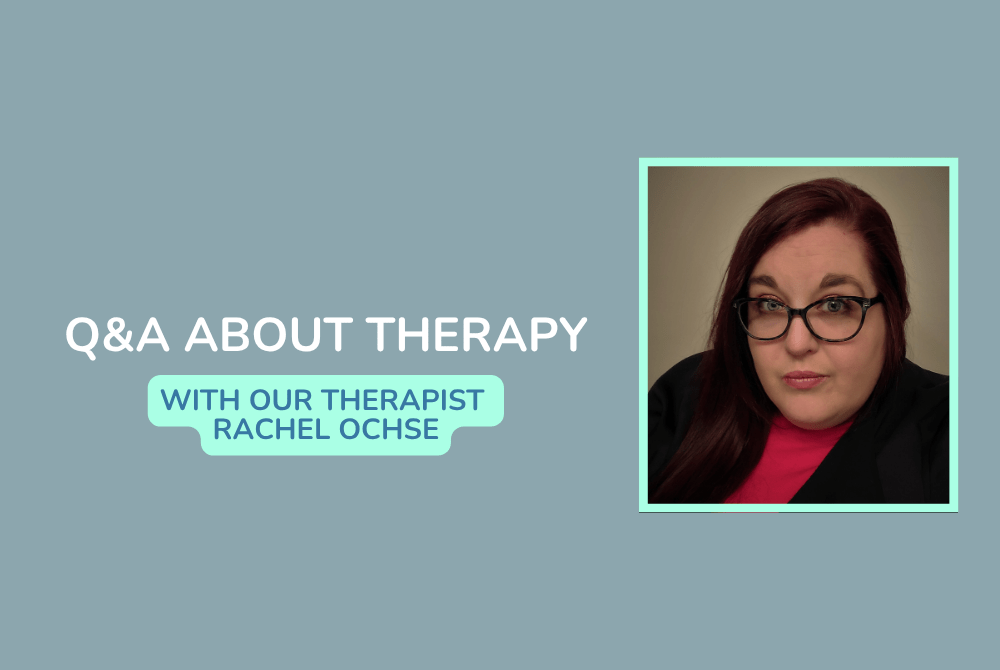
Q&A About Therapy with Rachel Ochse
Therapy isn’t just about reducing symptoms, it’s about understanding the deeper patterns, experiences, and emotions that shape how you move through the world. In this Q&A, Empowered Therapy therapist Rachel Ochse shares how she helps clients navigate trauma, intrusive thoughts, chronic illness, relationship complexity, and emotional dysregulation with curiosity and care. She explores the role of EMDR, shame resilience, and individualized treatment in helping clients feel safer in their bodies, more connected in their relationships, and better equipped to heal from experiences that may have felt overwhelming or misunderstood.
How do you approach therapy for clients in non-traditional or non-monogamous relationships without pathologizing them?
Answer:This was the question I tackled in my Clinical Research Project (dissertation) from my doctorate program. I created a measure and used it to study the underlying personal and professional characteristics of therapists that make them less likely to pathologize non-monogamous relationships
What are some common challenges you see in ENM or alternative relationships, and how do you help clients navigate them?
Answer: One significant challenge that I often see is that individuals are currently in a monogamous relationship and are struggling with intimacy or communication resulting in their desire to move to an open or polyamorous relationship.
*ENM/CNM/Poly relationships require SO MUCH MORE communication than monogamous relationships because there are more people and more feelings. Changing your relationship paradigm doesn’t fix struggling or doomed relationships and adding more people to the struggle just makes things messier.
My role as a therapist is to help the client understand the importance of clear communication, and help them find the words to articulate their needs, experiences, and expectations to their partner or partners.
How do you help clients understand the connection between past trauma and current physical symptoms or chronic illness without making clients feel like their physical illness is “all in their head”?
Answer: I think there is a lot of misunderstanding in the public, and the conception of mind, body, and soul being separate entities.
What many don’t realize is that our brain interprets physical and emotional pain signals in the same way, therefore whether you have broken your leg, or are struggling with the emotional impact of trauma it is all happening in your head… but that doesn’t mean it isn’t real.
Can this approach help if I’ve already tried medical treatments but still feel stuck or misunderstood?
Answer: Absolutely! Psychology was born out of the need to understand why some patients have symptoms that defy all reason and medical science.
Therapy is an active process in which I partner with my clients to discover the unique meanings of their physical symptoms and to address the underlying issues or traumas which are manifesting as physical symptoms or pain.
Often through gaining insight into the context around our emotional experiences we are able to resolve intrapsychic conflict and make our bodies feel safer to experience our feelings as emotions instead of somatic symptoms or intellectualizing ones experience.
How do you pace this work for clients whose bodies feel easily overwhelmed or dysregulated?
Answer: Pacing is one of the most important jobs of a trauma therapist. Many clients are very eager to “jump right in” to their trauma, not realizing that going too deep too fast will be experienced as a threat to the system.
Many times individuals with significant trauma will intellectualize (think their feelings rather than feel their feelings) allowing them to live in their heads rather than their bodies as the felt experience of emotion can be overwhelming.
I have found that trauma work is similar to helping someone who is terrified of water to learn how to swim; one does not simply shove a frightened person into a pool and call it a day.
Instead, as a caring loved one might do with a person who is terrified of drowning; you go slow, dipping your toes in and making sure that there is the felt sense of safety before wading deeper into the water.
How is your approach to EMDR different from short-term or protocol-based EMDR therapy?
Answer: EMDR is a manualized treatment created by Francine Shapiro, which has expanded greatly in utility since its creation over 30 years ago. Many therapists continue to practice EMDR as a short-term adjunctive therapy to handle discrete incidence of trauma.
However, I was trained by a clinician whose primary clinical interests were with complex trauma and dissociation (which are often the result of chronic traumas and/or microtraumas and emotional neglect). This work is akin to attempting to resolve a number of tangled fine chain necklaces by pulling one chain without breaking anything, it is delicate work requiring concentration and commitment from both the client and therapist.
Because there is work with fragile parts and issues, I have found it most beneficial to combine psychodynamic- relational psychotherapy with EMDR to tackle spots where talk therapy alone has been inefficient in addressing the client’s symptoms.
Am I a good fit for longer-term EMDR work if I’ve already done a lot of therapy but still feel stuck?
Answer: Yes, please! This is some of my favorite work. I have found that often when people are coming to me for EMDR they have had a great deal of therapy but have struggled with one or more issues that seem to not budge no matter how many times the issue arises.
While EMDR can rapidly resolve an individual’s subjective distress in minutes to hours, it also can be emotionally dysregulating as it will vividly expose one to aspects of their trauma before rapidly deescalating their trauma.
As a result I have found that individuals who have had extensive therapy are in a place where they have acquired the skills they need to emotionally regulate, and thrive working with me doing long-term EMDR work.
How do you differentiate between OCD and trauma-related intrusive thoughts, and does that change how you treat it?
Answer: Often when people are having intrusive thoughts there is a great anxiety about the underlying meaning of these thoughts and what it means about them as an individual.
I strongly believe in collaborative exploration of these symptoms with my clients to help determine their root cause, and the best way to reduce their occurrence.
As I have primarily worked with individuals with complex trauma over the last 13+ years I have seen many clients who have struggled with intrusive thoughts of a suicidal nature, which have stumped clients and their previous therapists.
What does treatment look like if my intrusive thoughts feel tied to past experiences or trauma?
Answer: What your treatment will look like will largely be dependent on what your priorities are in treatment. Depending on the needs and desires of my clients this is something that we could tackle via regular talk therapy or via EMDR, as it has protocols both for OCD and trauma-related responses.
I have been successful helping people manage intrusion symptoms using multimodal treatments tailored to their specific needs and wishes.
How do you approach this differently from traditional exposure-based OCD treatments like ERP? And can this work help if I’ve tried CBT or ERP before and it didn’t fully resolve things?
Answer: Absolutely. CBT and ERP are both behavioral treatments for trauma, whereas the work that I do is relational and insight oriented coupled with EMDR and parts work; which means that the purpose of the work is to gain understanding to help resolve intrapsychic conflicts that can lead to a person choosing to make behavioral changes.
Often managed care organizations promote manualized treatments like ERP and CBT as they tend to be standardized and offer the quickest relief for the majority of neurotypical individuals.
However, if you have OCD or Complex trauma you are not “the majority of neurotypical individuals,” and require a more complex and nuanced approach to treatment in order to resolve obsessions and compulsions.
How do you help clients reduce shame around intrusive thoughts that feel disturbing or “not like me”?
Answer: Every person has at least one thing they have done, the thought of which evokes deep guttural shame, and an accompanying belief that if others were to know this about you they would know your badness. However, shame cannot exist in the light.
When one is so brave as to share these thoughts, feelings, and experiences, and is met with compassion, care, and support it can be a transformative experience.